
Masada National Park – The Plateau
On the plateau you can visit fascinating archaeological complexes from the period of Herod, the rebels and the Byzantines.

To reserve – click here
Below is a description of some of the complexes:
The Northern Palace
The remains of Herod’s magnificent private three-tiered palace, with its mosaic floors and restored wall paintings.
The Northern Palace is a daring structure, built on the summit at the edge of a deep ravine, whose architecture reveals Hellenistic and Roman influence. It was constructed on three rock terraces, with a total height differential of about 30 m, requiring strong retaining walls. The top terrace served as Herod’s private residence, featuring four rooms and a central hall. The rooms were paved with geometric mosaic designs and the walls bore painted decoration. In the southwestern room, a mosaic was preserved with hexagonal designs in black and white, a pattern typical of Rome and its surroundings; its presence here may indicates the origin of the craftsmen’s inspiration.
A semicircular balcony, built off the terrace, was once surrounded by columns. The balcony overlooks the Judean Desert escarpment cliff, the Dead Sea and the Roman siege system. In the center of the middle terrace was a circular chamber surrounded by columns, of which only the foundations have survived.
This chamber was intended to provide space for hospitality and banquets. In the center of the lower terrace there was also a chamber surrounded by stoae. Its outer walls were decorated with stucco designs and the interior walls with frescoes (wall paintings on moist plaster) imitating multicolor marble slabs and geometric patterns. The palace also had a small bathhouse, where archaeologists uncovered three human skeletons, apparently the remains of rebels. A woman’s amazingly well preserved braids were also discovered in the bathhouse.
The Synagogue
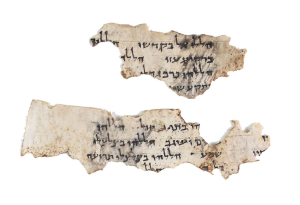
Remains of one of the only synagogues preserved from the time of the Second Temple, this structure served in Herod’s time as a stable and was converted into a synagogue by the rebels. Two pits dug into the floor of the room, where portions of biblical parchment were found, were apparently the synagogue’s genizah. Tiered stone benches were built against the walls. This is one of the few early synagogues that operated at the end of the Second Temple period. South of the synagogue, in the “casemate of the scrolls,” a rare collection of finds from the time of the revolt was discovered, including remains of scrolls and papyri.
The Room of the Lots
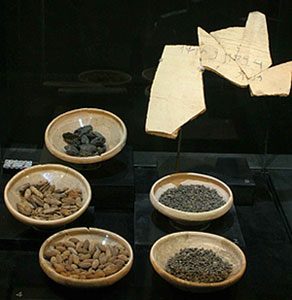
Inscribed potsherds were found here, mainly bearing the names of individuals, including “Benyair,” the commander of the Sicarii, the dominant group among the rebels of Masada. These may have been the lots cast by the rebels the night when they decided to take their own lives. Alternatively, they may have been associated with the administration of the rebels’ community life.
The Byzantine Church
The church was the gathering place for monastic hermits. Its main hall was paved with a multicolored mosaics and the walls were decorated with patterns made of potsherds and stones embedded in the plaster. The apse at the end of the hall was preserved in its entirety. Glass from the window in the apse wall was discovered in the courtyard, along with dozens of tiles that had covered the roof. In the western room of the church a mosaic floor was found featuring vegetal patterns and medallions depicting fruit and a basket of communion bread.
The Western Palace
This palace is the largest structure on Masada. Built during the time of Herod, it measures 3,700 sq m. Benches were built in the entrance room, and the walls were decorated with stucco designs. A chamber on the ground floor was presumably the “throne room,” as indicated by the four depressions discovered in the floor, in which the legs of the king’s throne may have been inserted. A staircase leads to the second story, which affords a view of the bathhouse with its magnificent mosaic floor.
The Bathhouse
The bathhouse was built in Roman style and all its rooms are well preserved. In the entrance is a courtyard surrounded by columns, which served as exercise space. The dressing room (apodyterium) is decorated with frescos and special floor tiles. During the revolt, a ritual immersion installation was built here. The opening in the wall leads to a stepped pool in the cold room (frigidarium). From the tepidarium an opening in the east leads to the hot room (caldarium), where the floor rests on small columns. Hot air flowing through clay pipes in the walls heated the room. The roof of the bathhouse affords a view of the entire plateau of Masada.
The Commander’s Headquarters
Situated near the Snake Path gate, this complex consists of a series of rooms decorated with frescoes. Most of the decorations are geometric patterns or imitation marble, and others feature vegetal designs.
The Southern Water Cistern
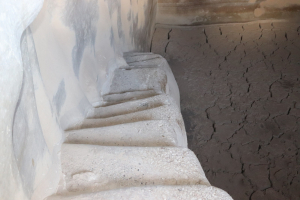
This large cistern is accessed by a flight of 64 steps. The wall near the steps bears an inscription, a remnant of a youth movement’s visit in 1941.
The History of Research at Masada
Masada was first identified in 1838 by the American scholars Edward Robinson and Eli Smith. The two first spotted Masada through a telescope from En Gedi and identified the shape of the northern cliff as Herod’s palace. Four years later the American missionary Samuel Wolcott and the British artist William Tipping climbed to the summit; both produced precise sketches and paintings of the site. In 1848, American naval officers visited the site and identified the cisterns. Following them, the scholar Félix de Saulcy excavated the Byzantine church and surveyed the Roman siege system.
Charles Warren and Claude Conder, of the Palestine Exploration Fund, surveyed Masada in 1865 and prepared precise sketches and maps of the site and the Roman camps. They also located the Snake Path.
In 1932, the German archaeologist Adolf Schulten spent about a month at Masada. His work became the foundation for subsequent research, although he mistakenly identified the Northern Palace as a fortification system built at the upper end of the Snake Path.
In the 1940s, the archaeologist Shmarya Guttman led youth movements to Masada and turned the mountain into a symbol. He was the impetus that led to the first Israeli excavation at Masada in 1953, which identified the water supply system, discovered the full route of the Snake Path and identified the Northen Palace as Herod’s palace. The expedition also excavated Roman siege camps A and C. In 1956, an expedition of senior Israeli archaeologists returned to the mountain for 10 days. Among them were Nahman Avigad. Michael Avi-Yonah, Yosef Aviram, Yohanan Aharoni and Shmarya Guttman.
In 1963, the expedition headed by Yigael Yadin began its excavations. Over two seasons in the field, nearly the entire site was excavated. Excavations of parts of Masada continued later under Ehud Netzer and Guy Stiebel.
To reserve a visit to the site:
Searching Availability…
You might be interested too


Related Reserve Parks
related pages